
Which Monero wallet should a privacy-conscious U.S. user choose? A practical explainer of Cake Wallet and its XMR features
How private is “private enough” when you move value on the internet? For many U.S.-based privacy-conscious users, that question reduces to the wallet: the software you run, the keys you control, and the network path your transactions take. This article walks through how an advanced multi-currency wallet — with specific Monero (XMR) features — tries to defend privacy in three dimensions (key custody, network anonymity, and protocol-level obfuscation), where those defenses are strongest, and where users still need to make choices and accept trade-offs.
Short version up front: a wallet that combines a non-custodial architecture, device-level encryption, subaddress support for Monero, Tor/I2P routing, and hardware-wallet integration substantially raises the bar for practical surveillance. But no single app can erase every risk: usability choices, node trust, and local device security all matter. Below I explain the mechanisms, compare alternatives, and give straightforward heuristics you can reuse.
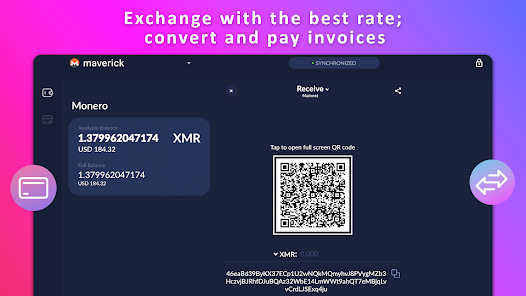
How Monero privacy works in a wallet: mechanism, not magic
Monero’s privacy comes from three protocol components: ring signatures (mixing inputs), confidential transactions (hiding amounts), and stealth addresses (recipient anonymity). A wallet is the user’s interface to those features; it can implement them correctly or weaken them by poor defaults or bad network choices.
Key custody is primary. In an open-source, non-custodial wallet the private spend and view keys remain under user control. A sensible design keeps the private view key local (and ideally never exports it) while using background synchronization to fetch outgoing and incoming transactions efficiently. When the private view key never leaves your device, external services cannot trivially scan your funds. That mechanism is what lets users inspect balance and transaction details locally while avoiding server-side profiling.
Network anonymity is the second axis. Even with Monero’s on-chain privacy, node-level metadata (IP addresses, connection timing) can leak correlations. Tor-only routing or I2P proxy support forces all node connections through anonymity networks, drastically reducing direct IP-level linkage. Allowing custom node selection — including running your own remote node — lets users trade convenience for stronger network-level isolation.
What Cake Wallet brings to Monero users and how to weigh it
The wallet in question combines several defensive mechanisms relevant to U.S. privacy-minded users: strict no-telemetry, device-level encryption using Secure Enclave/TPM, Tor/I2P support, subaddress handling, hardware-wallet integration (Ledger and an air-gapped Cupcake option), and multi-platform availability across iOS, Android, macOS, Windows, and Linux. Those features align with three practical goals: minimizing remote data collection, protecting keys at rest, and reducing network-level leaks.
Importantly, the project is open-source and non-custodial. That matters because code transparency lets the community and independent auditors verify claims like “the private view key never leaves the device” and “no telemetry is collected.” Open-source status is not a binary guarantee of perfect security, but it materially improves trust compared to closed-source wallets.
For users who want a single tool for Monero plus other coins (BTC, LTC, ETH, ZEC, and more), the ability to manage multiple assets in one interface is convenient. Cross-chain swaps via decentralized routing (NEAR Intents) avoid centralized swap services, reducing counterparty risk, and built-in swap access lowers the need to move funds to external exchanges — a vector that often weakens privacy. If you prefer keeping all flows inside one app, that matters.
Concrete trade-offs — where the design shines and where it requires user judgement
Stronger defaults: Mandatory shielding for Zcash and PayJoin v2 for Bitcoin are examples where the wallet enforces privacy-by-default. For Monero, support for background sync and subaddresses reduces accidental address reuse and stale key exposure. The inclusion of Tor-only mode and the ability to choose custom nodes enables network hardening.
Usability trade-offs: Tor/I2P and running your own node improve anonymity but add latency and complexity. Tor-only mode can complicate connectivity on restrictive mobile networks or enterprise Wi‑Fi. Running a full Monero node is the strongest privacy posture, but disk, bandwidth, and configuration burdens push many users toward trusting a remote node; picking a trustworthy node — or using a remote node you control — is therefore a central operational decision.
Hardware integration: Ledger and air-gapped hardware support reduce risk from device compromise, but they introduce UX friction: transaction signing requires extra steps, and air-gapped workflows can be intimidating for non-technical users. For high-value holdings, the trade-off almost always justifies the overhead; for small, frequent payments it might not.
Cross-asset complexity: Supporting many coins (Monero, Bitcoin, Litecoin with MWEB, Ethereum, etc.) is a pragmatic strength, but each asset brings its own privacy semantics. For example, Litecoin’s MWEB offers optional privacy — users must actively enable it. Zcash shielding is enforced by the wallet to avoid accidental transparent outputs, but migrating seeds from some other wallets (Zashi) may be impossible without manual transfers. Users should treat each asset’s privacy features as distinct tools, not a single uniform guarantee.
Comparing 2–3 alternatives: when Cake Wallet fits, and when another choice might be better
Option A — Full-node Monero wallet (run on a dedicated machine): Best privacy. Running your own Monero node gives the cleanest network isolation, because you don’t reveal your IP to third-party nodes. The downside is resource cost and setup friction — not ideal for mobile-first users.
Option B — Lightweight non-custodial wallets with Tor and hardware-wallet integration (the subject wallet sits here): Best balance for most privacy-conscious Americans who want mobile access and multi-currency management. You trade some trust in remote nodes unless you connect to your own. The wallet’s device-level encryption and strict no-telemetry policy reduce many practical attack surfaces.
Option C — Custodial privacy services or centralized exchanges with privacy features: Convenient but weakest. Even if an exchange offers privacy-enhancing tools, custody means they control keys and they can be compelled by legal process. Avoid this path if regulatory exposure or personal anonymity is a priority.
One reusable decision heuristic
If you can answer three questions, you will be close to the right wallet posture: (1) Do you need mobile access? (2) Will you accept running your own node or prefer usability? (3) Are you protecting large, stationary holdings or making many small payments? If you require mobile + multi-asset access and are willing to use Tor or select trusted remote nodes, the middle path — a well-configured non-custodial wallet with hardware signing — is the pragmatic default. If you prioritize maximal network anonymity and can host infrastructure, run a full node.
For readers who want a hands-on single-app solution that follows these principles, consider the practical features and trade-offs of cake wallet as you evaluate setup: its no-telemetry rule, device-level encryption, Tor/I2P support, Monero subaddress handling, and hardware wallet options make it a strong contender for privacy-minded U.S. users who value cross-chain convenience.
What still breaks privacy — limitations and risks to watch
Local device compromise remains the single most consequential risk. Malware, bad backups, or compromised Secure Enclave/TPM paths can expose keys or reveal usage patterns. PINs and biometrics are an access layer but not an absolute defense; they protect casual attackers and provide convenience for legitimate users.
Network timing analysis is a subtle limit: even when using Tor, adversaries who can observe both ends of a communication path (entry and exit nodes, or ISP + node) can mount correlation attacks. Tor and I2P mitigate but do not entirely eliminate this risk. Running a full node or using multiple network protections reduces attack surface but cannot produce mathematical anonymity guarantees in an adversarial, global-observer scenario.
Multi-asset user behavior can leak metadata. Repeatedly moving funds between chains through swaps or centralized services creates temporal correlations that sophisticated analysis can exploit even if individual chains are private. Decentralized routing (NEAR Intents) reduces centralized intermediaries, but it does not make cross-chain swaps invisible to timing or exchange-participant analysis.
What to watch next: practical signals that matter
Three near-term signals should shape choices: updates to node discovery and consensus rules for Monero (which could change sync behavior), improvements or regressions in Tor/I2P performance on mobile, and hardware-wallet firmware changes that affect Monero signing. Because the wallet is multi-platform and open-source, security updates and audit results will be the clearest signals of continued reliability; subscribe to project channels and inspect release notes before major upgrades.
Regulatory signals matter too. In the U.S., regulatory scrutiny of privacy tools evolves; wallets that make data collection minimal and keep keys local are better positioned to resist forced surveillance of third-party servers, but they cannot prevent lawful seizures of user devices. Operational security (air-gapped backups, multisig where available) remains essential.
FAQ
Q: Does using a wallet with Tor mode make Monero transactions 100% anonymous?
A: No. Tor reduces IP-level leakage but does not change Monero’s protocol guarantees. Monero already protects amounts and addresses on-chain; Tor mainly protects the network link between your device and the node. Tor reduces one class of metadata leaks but cannot defend against device compromise or global passive observation that correlates timing.
Q: Should I run my own Monero node, or is using a remote node OK?
A: Running your own node is the strongest privacy posture because it removes reliance on third-party nodes that could log connections. However, full nodes require storage, bandwidth, and occasional maintenance. If you prefer a mobile-first setup, choose a wallet that supports Tor and trusted custom nodes, and consider rotating nodes or using remote nodes you control to reduce trust.
Q: How does hardware wallet integration affect Monero privacy?
A: Hardware signing isolates private spend keys from the potentially connected device, limiting theft from malware. It raises the bar significantly. The trade-off is extra setup complexity and slower workflows. Air-gapped solutions are the strongest but require disciplined backup and signing procedures.
Q: Are cross-chain swaps via NEAR Intents private?
A: NEAR Intents decentralize routing to market makers and avoid central custodians, reducing counterparty risk. They improve operational privacy relative to centralized exchanges, but timing and participant metadata can still leak correlations. Treat them as privacy-improving, not privacy-perfect.